Dead hedging: turning waste into habitat
A dead hedge is one of the simplest ways to turn what might otherwise be considered garden (or woodland) waste into something useful. Made by weaving, stacking or loosely layering cut branches, twigs and other woody material between posts, a dead hedge can form a boundary, screen or wildlife habitat — without the need to buy new materials.
Within a woodland, arisings from coppicing, hedgerow management or clearing paths, can be put to use as a dead hedge. The example shown here is from Hailey Community Woodland, where a dead hedge has been created around an area of coppiced Hazel (this is multi-stemmed Hazel that is periodically harvested) in order to deter deer from browsing off the new shoots.
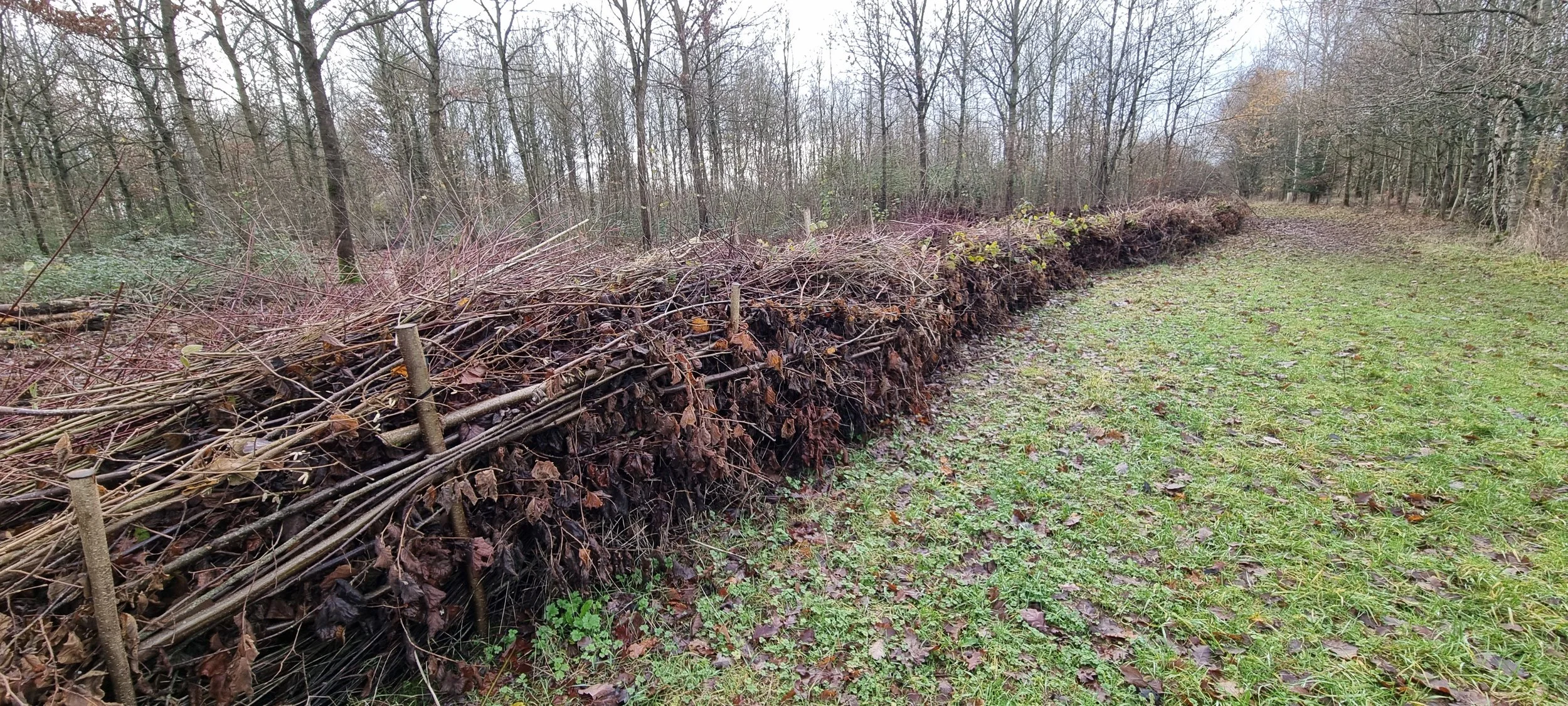
A dead hedge within a 25 year old woodland managed for the use of the local community and to support wildlife
I love to use existing and found materials in my gardening. By observing what is already available, we can minimise inputs, and reduce waste - often the most sustainable material is the material we already have! Instead of How do I get rid of this? try to think What could this do here?
Many gardeners think of the cutting from annual pruning of shrubs, or hedge trimmings, as something to dispose of, but in fact, it is a resource with several possible uses! It might become mulch, habitat, a support for plants, a wildlife structure, firewood or, eventually, organic matter.
Rather than loading branches into a vehicle and transporting them to a recycling centre, composting facility or green-waste collection point, a dead hedge keeps that material where it was grown. This avoids some of the energy and emissions associated with collecting, transporting and processing garden waste. It also means that nutrients and carbon contained in the woody material remain within the garden or site, gradually returning to the soil as the hedge breaks down.
A home for wildlife
Dead hedges can be surprisingly rich habitats. The gaps and layers provide shelter for insects, spiders and other invertebrates, while birds can use them for cover and foraging. Small mammals, amphibians and reptiles may also find protection among the branches, particularly where a dead hedge is built close to other habitats such as long grass, ponds, compost heaps or living hedges.
As the wood gradually decomposes, fungi, mosses and microorganisms move in, adding another stage to the ecological life of the hedge. What begins as a collection of dead branches can become a changing habitat.
Easy, adaptable and essentially free
The basic construction is straightforward: drive a pair of sturdy stakes into the ground, add another pair alongside them, and pack the space between with branches and woody cuttings. Continue along the line, adding material as it becomes available. Larger branches can form the structure, while smaller twigs and prunings fill the gaps.
There is no need for everything to be neat or uniform. In fact, irregularity can be an advantage. A loosely constructed hedge can provide a greater variety of spaces and textures for wildlife.
You ill be surprised at how quickly the material breaks down and sinks, meaning that next year you can continue to add more!
A creative opportunity
Dead hedges also challenge our ideas about what a garden is supposed to look like. Instead of treating every fallen branch or pile of prunings as untidy waste, they invite us to see potential in natural materials.
They can be deliberately sculptural, used to define curves and spaces, create informal screens or mark changing areas within a garden. Different sizes and species of wood can produce different textures, and a dead hedge can evolve over time as new material is added.
This is where practicality and creativity meet. Rather than buying fencing, screening or decorative structures, gardeners can make something distinctive from the materials already present on site.
If you want to make a slighty more sophisticated dead hedge, sourcing some additional woody material for stakes, and to secure the top, is another option, and I give an example of this below.
A dead-hedging collaboration with A Place for Nature
I worked recently with fellow wildlife gardeners from A place for Nature, to rejuvenate an overgrown and unmanaged hedge, mainly comprised of Cherry and Blackthorn. We decided it was not suitable for hedgelaying, as the neighbours wanted to retain some of the height for privacy. Instead the sparse overhanging branches were cut back, and we created a dead-hedge along the very gappy base, using Hazel stakes to secure the arisings. In this instance we decided to thread the dead branches in and out of the stakes, giving a nice woven effect.
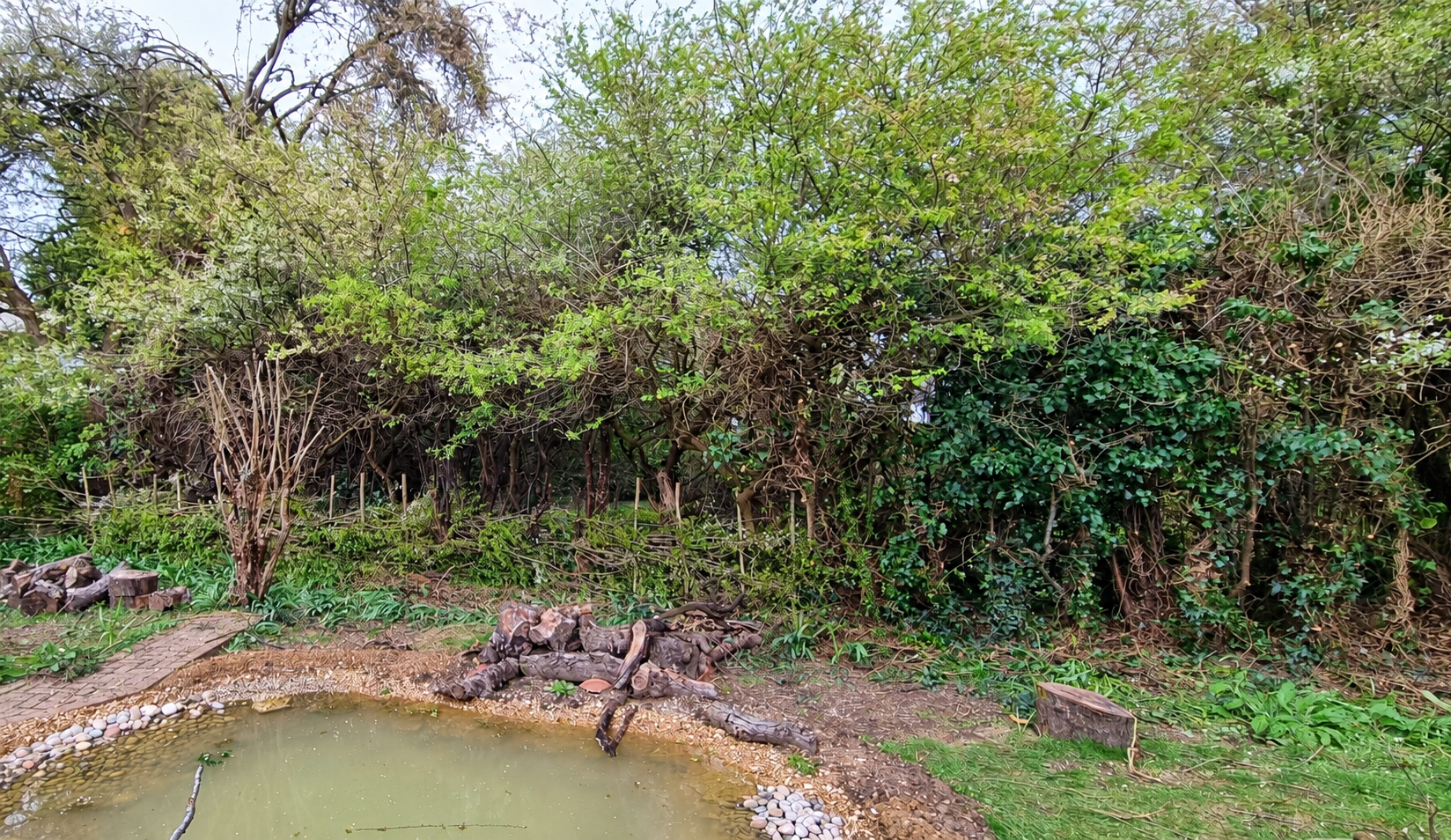
Dead-hedging in progress, behind a
The Hazel stakes we used were coppiced (i.e. cut down to the ground), from a stand of Hazel managed for this purpose by The Wychwood Forest Trust in Foxborough Woods, West Oxfordshire.
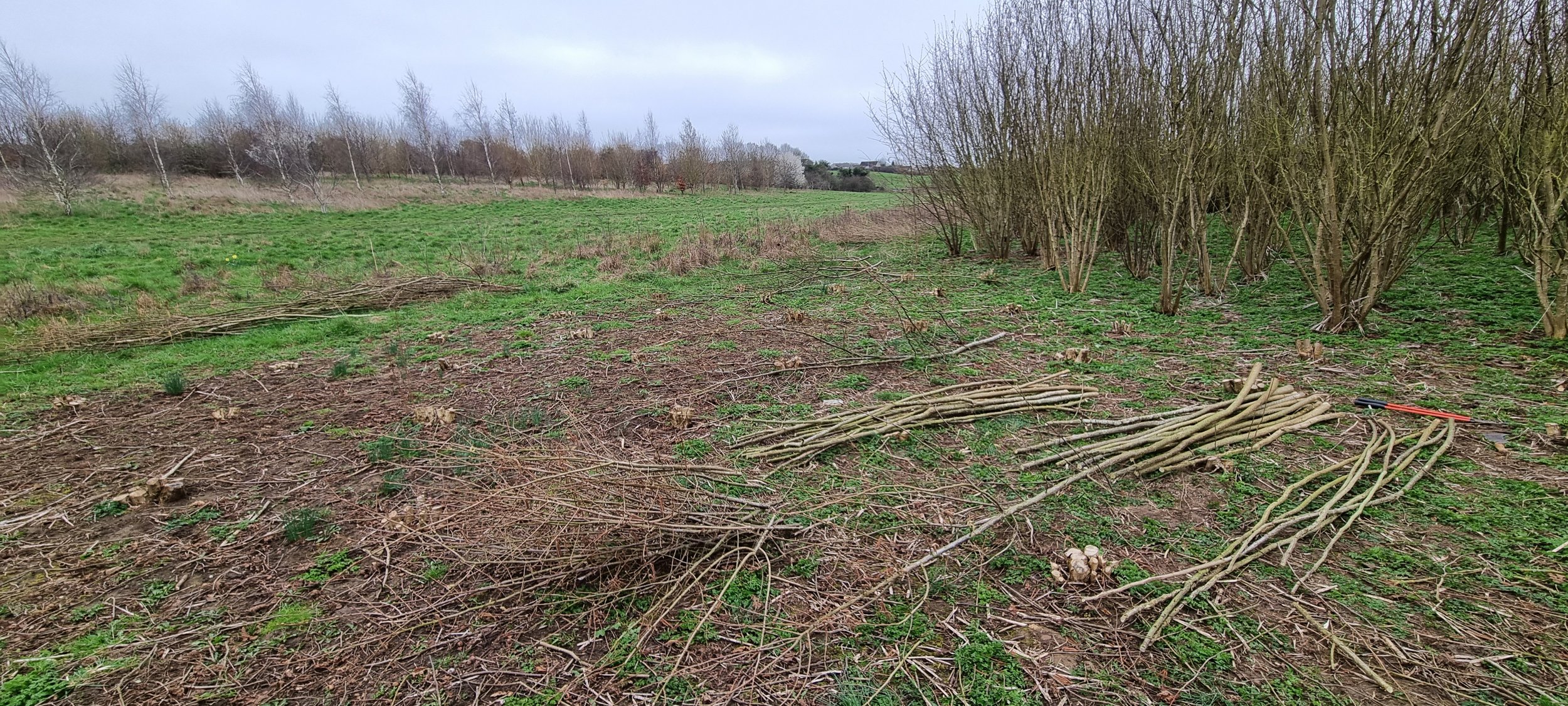
A Hazel copse with coppiced stakes and binders
We then used Hazel ‘binders’ - longer, thinner stems, also from coppice - to bind the top of the stakes with the method used in Midland-style hedgelaying. This is essentially two sets of two binders twisted around each other, the pairs then twisted around each other as they are also woven in and out of the stakes. The result is a nice solid structure - in hedgelaying the aim to to help make the hedge impervious to sheep and cattle - but also a very decorative and sculptural feature.
