Over the past few weeks I’ve started taking part in a really inspiring series of propagation and training sessions with the Long Mead Foundation, focused on growing native wildflowers for orchard meadow restoration, on behalf of Hailey Community Woodland.
Participants include representatives from a number of local community orchards and woodland projects which recently received fruit trees through a West Oxfordshire District Council initiative, called Coronation Community Orchards, which also initiated and funds these training sessions. Alongside learning practical techniques for establishing native wildflowers, the sessions are also creating valuable opportunities to share experiences between different sites and groups across the area.
During our first session in late April, we collected molehill soil from a nearby meadow to mix with compost made on site from woodchip. Using a carefully developed propagation method, developed by Catriona Bass and her team through meticulous trials and record keeping over several years, we then sowed seeds of Common Knapweed (Centaurea nigra) and Red Campion (Silene dioica). These were collected last year from Long Mead’s extraordinary floodplain meadow — one of the best remaining examples of traditional floodplain grassland in the country — and kept either in the fridge or in a dry and cool location, since then.
It was very exciting to see after just two weeks our seeds have germinated, and the two cotyledon leaves (the embryonic leaves formed within the seed, which often look very different to the true leaves) are showing! Can you tell which one was sown carefully with a grid, and which one was scattered quickly?
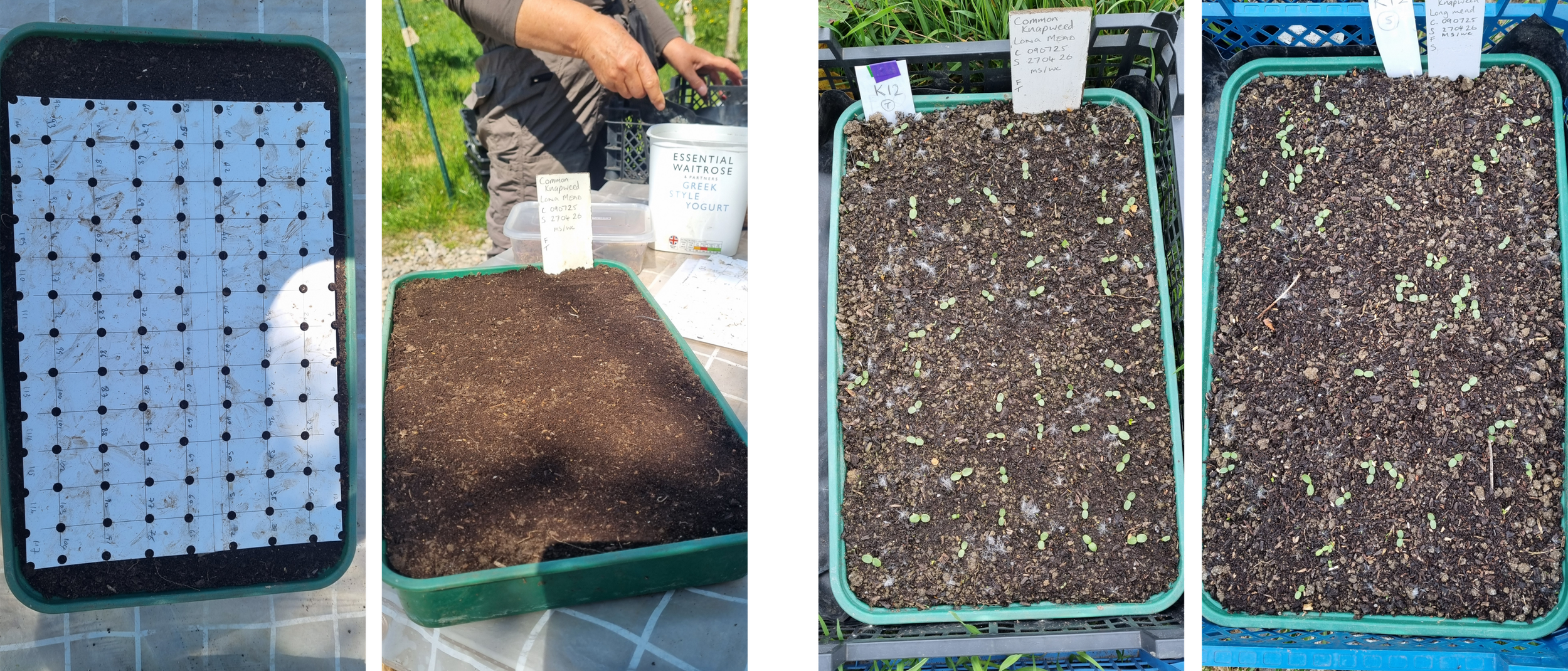
Sowing Common Knapweed seeds using a grid, and seedlings showing two weeks later
This week we were joined by FarmAbility, an organisation that supports adults with learning disabilities and autism through practical farm-based activities. Their participants regularly help with native plant propagation at the nursery, and it was great to see how naturally the sessions bring together people with a wide range of skills, backgrounds and experiences.
As well as sowing lots more seeds, including Bladder Campion (Silene vulgaris) and Field Scabious (Knautia arvensis), we took a glorious walk through the very special Long Mead, a floodplain meadow over 1000 years old. Although not yet in it’s full flowering glory, we saw species such as Meadow Buttercup (Ranunculus acris), Cuckoo-flower or Lady’s-smock (Cardamine pratensis; fewer than usually, due to the very dry weather) Early Marsh Orchid (Dactylorhiza incarnata ssp. incarnata; many drooping over, again due to the dry weather), and Great Burnet (Sanguisorba officinalis) in flower. We also spotted the curious Adder’s-tongue Fern (Ophioglossum vulgatum), which is noted for its distinctive single leaf with a fertile spike that resembles a snake’s tongue.
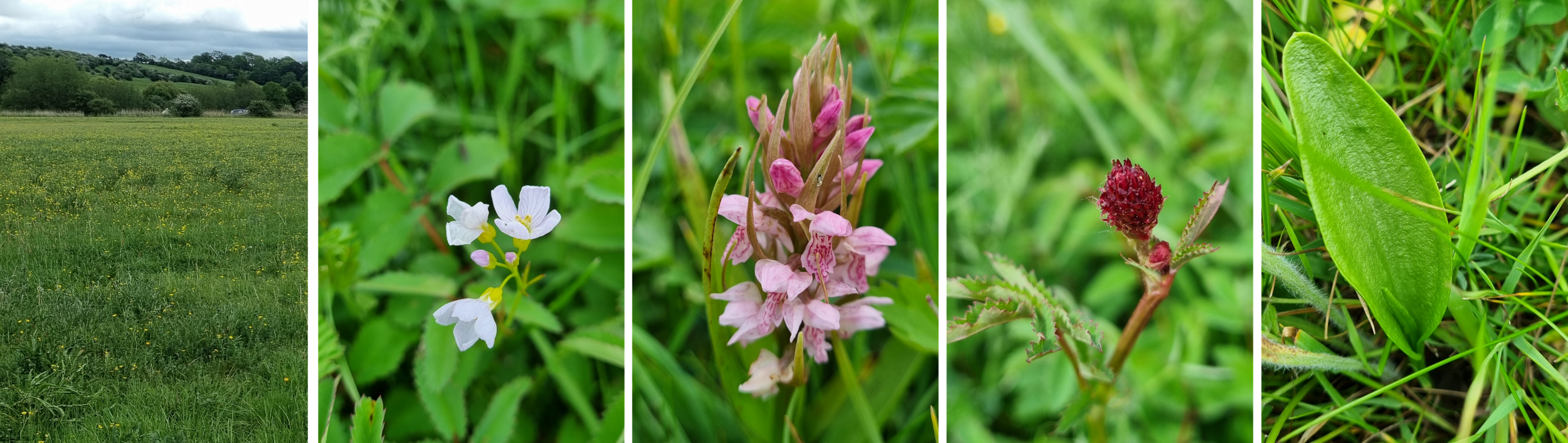
Long Mead, a 1000-year old floodplain meadow on the river Tames in Oxfordshire
The longer-term aim of this project is to grow on a range of native meadow species which can later be planted into our community orchards to help enrich the ground flora and support pollinators and other wildlife. It’s exciting to feel part of a wider community network working towards connected, biodiverse landscapes at a local scale.
In Hailey Community Woodland our orchard sits within the wider community woodland, mainly in a large central grassland clearing with a few trees also within a smaller clearing where some Ash trees previously succumbed to Ash die-back. As a community we planted these out last February (2025), and they are doing well!
